
The best prompt frameworks and which ones actually hold up
 By Moazzam Ali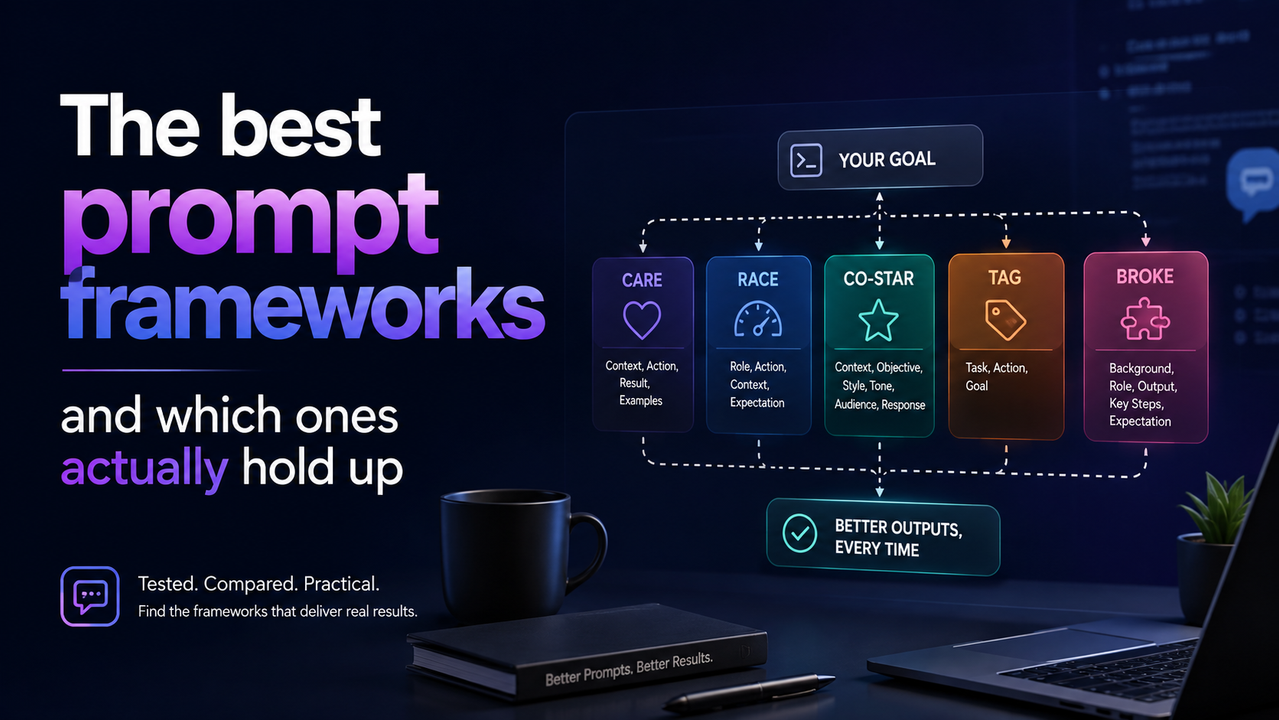
Search "prompt frameworks" and you get the same article twenty times: a numbered list of acronyms — RTF, CO-STAR, RISEN, CRISPE, RACE, APE — each with a one-line definition, presented as if they were interchangeable tools of equal standing.
They are not of equal standing. Three of the techniques on those lists come from published research with measured results. The rest are mnemonics somebody invented for a blog post. Both kinds are useful, but for completely different reasons, and confusing them is why people follow a framework to the letter and still get mediocre output.
Here is the honest version.
Which prompt frameworks are backed by research?
Three, and they are techniques rather than templates. None of them is an acronym you fill in.
Few-shot prompting
Show the model two or three examples of the input-output pattern you want, then give it the real input.
This came out of the GPT-3 paper — Brown et al., Language Models are Few-Shot Learners, 2020. The finding that made it famous was that large models could pick up a task from examples in the prompt alone, without any fine-tuning.
It is still the single highest-leverage thing you can do when the output needs to match a specific shape. Classification into your own categories, extraction into your own schema, matching a house style — examples beat description every time, because you are showing the target rather than describing it.
Classify each support ticket as: billing, bug, feature-request, other.

"I was charged twice this month" → billing
"The export button does nothing on Safari" → bug
"Any chance of a dark mode?" → feature-request

"My invoice says $49 but I'm on the $29 plan" →
Two caveats worth knowing. Your examples teach format and bias — if all three examples are billing tickets, expect more billing answers. And examples cost tokens on every call, so for very high-volume tasks there is a point where fine-tuning is cheaper.
Chain-of-thought — and why the famous phrase is now obsolete
Wei et al., Chain-of-Thought Prompting Elicits Reasoning in Large Language Models, 2022. Asking a model to work through intermediate steps before answering substantially improved performance on arithmetic and multi-step reasoning. The trick that spread everywhere was appending "let's think step by step."
On a modern reasoning model, stop doing that. It is the most out-of-date advice still circulating in prompt guides.
Chain-of-thought did not stop working. It moved inside the model. GPT-5, Claude's extended thinking and Gemini's deep-think modes all reason internally before answering, and they expose that as a parameter — a reasoning effort or thinking budget you set on the request — rather than a phrase you paste into the prompt. Telling a model that already reasons to "think step by step" adds tokens and clutter, and occasionally makes things worse by pushing visible rambling into a response that should have been clean.
What replaced the phrase is a decision, not an incantation: how much reasoning is this task worth? Rewriting a subject line deserves minimal effort. Debugging a race condition deserves the maximum. That is now a dial you turn, and knowing when to turn it up is the actual skill.
If you are working with an older or smaller model without a reasoning mode, the original technique still applies exactly as published.
ReAct
Yao et al., ReAct: Synergizing Reasoning and Acting in Language Models, 2022. The model alternates between reasoning about what it needs and taking an action to get it — search, look up, calculate — then reasons again over the result.
You will mostly meet this one built into agent frameworks rather than typing it yourself. It matters here because it marks the boundary of what prompting can do: when a task needs information the model does not have, no amount of clever wording fixes it. You need tools, and ReAct is the loop that uses them.
What about RTF, CO-STAR and the rest?
These are checklists. Nobody ran a study. Someone noticed that good prompts tend to contain the same handful of elements, arranged them into something pronounceable, and wrote it up.
That is genuinely useful — just not for the reason the listicles imply. A checklist stops you forgetting the audience. It does not contain hidden knowledge about how language models work.
RTF — Role, Task, Format. The minimum viable prompt, and the one to reach for by default. Most bad prompts are missing at least one of the three.
CO-STAR — Context, Objective, Style, Tone, Audience, Response format. Credited to GovTech Singapore's Data Science & AI team, and popularised by Sheila Teo, who used it to win GovTech's 2023 GPT-4 prompt engineering competition against more than 400 entrants. It is the most complete of the mnemonics and the best fit for anything written for an audience, because it separates style from tone — a distinction most people collapse and then wonder why the output sounds wrong.
RISEN — Role, Instructions, Steps, End goal, Narrowing (constraints). Suits multi-step tasks where you already know the procedure and want it followed in order.
CRISPE — Capacity/Role, Insight, Statement, Personality, Experiment. The "experiment" step asks for several variations, which is its one genuinely distinctive idea: when you do not know what good looks like yet, generate options rather than one answer.
Pick one and use it consistently. Which one matters far less than having any repeatable structure, because the value is in not forgetting things.
If you want to see a checklist already filled in, the Vault’s PRD prompt template is CO-STAR in practice: context, objective, audience and format, each as a fill-in field. Copy it and the checklist comes with it.
What every good prompt actually contains
Strip the acronyms and the same components appear underneath all of them:
| Component | The question it answers | Skipping it causes |
|---|---|---|
| Role | Who should the model be? | Generic, hedge-everything answers |
| Task | What exactly should it produce? | Something adjacent to what you wanted |
| Context | What does it need to know? | Confident, plausible, wrong |
| Audience | Who reads this? | Right content, wrong register |
| Constraints | What must it avoid or respect? | Clichés, wrong length, invented facts |
| Output format | What shape should it arrive in? | A wall of prose you reformat by hand |
| Examples | What does good look like? | Near misses you cannot quite diagnose |
That is the transferable lesson. Every framework on every list is a different mnemonic for some subset of this table.
Two of these do the most work and get skipped the most often. Constraints are where you spend your knowledge of the domain — "no phrases like 'in today's fast-paced world'", "cite the source or say you don't know", "assume the reader already knows what an API is". And output format is what converts a good answer into something you can use without editing.
Which framework should I use?
| If you are… | Use | Because |
|---|---|---|
| Writing anything for an audience | CO-STAR | Style and tone are separate fields |
| Firing off a quick request | RTF | Three fields, thirty seconds |
| Following a known procedure | RISEN | Steps are explicit and ordered |
| Exploring, no fixed target yet | CRISPE | Asks for variations, not one answer |
| Needing a specific output shape | Few-shot | Examples beat description |
| Working on something hard | Raise the reasoning effort | The model already thinks; let it think more |
| Needing facts you have not supplied | Tools / ReAct | No prompt can invent what it does not know |
One request, three frameworks
Start with what most people actually type:
write a blog post about remote work
RTF gets it to workable:
Role: You are a workplace culture writer for a B2B software audience.
Task: Write a 1,200-word blog post on managing remote teams.
Format: Markdown, H2 sections, a two-sentence takeaway at the end.
CO-STAR adds the parts that decide whether anyone finishes reading:
Context: Our readers are people managers at 50–500 person companies
  who already run hybrid teams. They are past the 2020 debate.
Objective: Give three practices that measurably improve async output.
Style: Analytical, concrete, closer to a field report than an essay.
Tone: Direct and collegial. No hype.
Audience: Managers with 3+ years of experience. Assume fluency.
Response: Markdown. H1, four H2s, 1,200 words, two-sentence takeaway.
RISEN suits it if you want a fixed procedure rather than a fixed shape:
Role: Workplace culture writer for a B2B software audience.
Instructions: Write a 1,200-word post on managing remote teams.
Steps: 1) Open with a specific scenario, not a statistic.
       2) Three practices, each with a concrete example.
       3) Name the failure mode of each practice.
       4) Close with what to do on Monday morning.
End goal: A manager changes one thing about their next week.
Narrowing: No "new normal", no "unprecedented". One counter-argument,
       answered honestly. Short paragraphs.
Notice how much they overlap. The gain from the vague version to RTF is enormous. The gain from RTF to CO-STAR or RISEN is real but much smaller — mostly in constraints and audience. That ratio is the whole story: structure at all beats no structure, and which structure you pick is a detail.
The short version
- Few-shot, chain-of-thought and ReAct come from research. Learn what they do.
- Do not append "think step by step" to a reasoning model. Set the effort instead.
- RTF, CO-STAR, RISEN and CRISPE are checklists, not science. That is fine — use one anyway.
- The components matter more than the acronym. Role, task, context, audience, constraints, format, examples.
- Constraints and output format are the two people skip and the two that change the result most.
The frameworks are training wheels, and that is not an insult. You use them until the components are automatic, and then you stop noticing you are using one.
For the makeover version of this advice, with a before and after you can run yourself, read How to Write Better AI Prompts.